

Power system analysis faces unprecedented complexity in 2025 as engineers tackle increasingly intricate electrical networks worldwide. With aging infrastructure reaching critical thresholds and renewable integration transforming traditional grid operations, the analytical challenges have multiplied exponentially. Additionally, cybersecurity vulnerabilities in control systems create new dimensions of risk that require sophisticated modeling approaches.
At Paragon Energy Networks, we recognize that effective power system analysis requires both advanced computational tools and deep engineering expertise. The convergence of distributed energy resources, bidirectional power flows, and dynamic load profiles demands more sophisticated analytical methods than ever before. Consequently, engineers must master everything from Newton-Raphson load flow techniques to AI-based stability assessment to ensure grid reliability. Engineers conducting power system analysis in 2025 face unprecedented technical hurdles that threaten grid stability and reliability. These challenges have evolved far beyond conventional analysis problems, requiring new approaches and methodologies to ensure continued system integrity.
Aging Infrastructure and Load Growth Conflicts
The power grid confronts a fundamental conflict between deteriorating infrastructure and rapidly accelerating electricity demand. First and foremost, the aging physical components pose a significant reliability risk—70% of power transformers are 25 years or older, 60% of circuit breakers exceed 30 years of service, and 70% of transmission lines have surpassed their quarter-century mark [1].
Grid Congestion and Renewable Integration Bottlenecks
Grid connection processes have emerged as a major bottleneck for power system transformation. Currently, the proposed capacity-seeking grid connection is more than double the total installed capacity of the U.S. power plant fleet (2,600 GW vs. 1,280 GW) [2]. In particular, the time required to secure a connection has increased by 70% over the last decade, while withdrawal rates remain persistently high at 80% [2].
Interconnection costs have more than doubled during this same period, creating financial hurdles for new projects [2]. In some regions, renewable curtailment has reached alarming levels—certain provinces in China have experienced up to 40% curtailment of wind power generation capacity [3]. Importantly, these bottlenecks directly threaten decarbonization goals.
Cybersecurity Threats in SCADA and EMS Systems
Supervisory Control and Data Acquisition (SCADA) and Energy Management Systems (EMS) now face sophisticated cyber threats targeting critical infrastructure. Cyberattacks on U.S. utility companies increased nearly 70% from 2023 to 2024 [5]. Furthermore, the financial impact continues to grow—IBM’s 2024 Cost of a Data Breach Report found that the average attack costs organizations $4.88 million, a 10% increase from the previous year [5].
Modeling Complex Power Networks with Modern Tools
Effective modeling of complex power networks requires specialized computational tools that can handle the intricacies of modern electrical grids. Modern analysis approaches combine advanced mathematical frameworks with intuitive visualization capabilities to help engineers tackle increasingly complicated power system challenges.
PowerWorld Simulator for Real-Time Visualization
PowerWorld has established itself as a leading platform for visualizing real-time power system conditions directly in the control room or remotely. The software bridges the often-disconnected worlds of real-time operations and planning [6]. Through its Retriever module, engineers can visualize data from SCADA, EMS, or state estimators, providing enhanced situational awareness across wide geographical areas [6]. This functionality allows operators to create power flow cases from real-time state estimator data, essentially bringing planning tools into the real-time environment [7].
At ISO New England, PowerWorld implementation followed a three-phase approach that culminated in large-scale wallboard displays for control room operations [8].
Building Y-Bus and Z-Bus Matrices in Large Systems
The foundation of power system analysis lies in matrix representations of network elements. Y-bus (admittance) and Z-bus (impedance) matrices serve as mathematical frameworks for analyzing power flows and fault conditions, respectively.
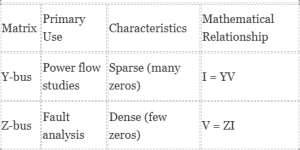
The Z-bus is essentially the inverse of the Y-bus (Z = Y^-1) [9]. Although both matrices represent the same network, they serve different analytical purposes. Engineers typically choose the Y-bus for power flow problems because its sparsity enables efficient iterative solutions [9]. Alternatively, Z-bus becomes valuable in fault analysis since its diagonal elements represent the Thevenin equivalent impedances seen at each bus [9].
For large-scale systems, methods exist to determine these matrices from recorded synchrophasor measurements, treating bus injection currents as signals produced by a random process [10]. Load flow calculations form the cornerstone of modern power system analysis, especially in densely populated grids where complexity reaches its peak. As electrical networks grow denser, engineers must employ increasingly sophisticated methods to solve nonlinear power flow equations efficiently.
Newton-Raphson vs Fast Decoupled Load Flow
The Newton-Raphson (NR) method offers excellent convergence characteristics for solving power flow problems. It handles heavily loaded systems with phase shift angles up to 90° and remains reliable even with ill-conditioned systems [1]. The method achieves high accuracy in just a few iterations due to its quadratic convergence properties.
Recent tests confirm FDLF’s efficiency—a microgrid analysis showed it produced minimum power losses of 0.219 pu (real) and 57.876 pu (reactive) [13].
Sparse Matrix Techniques for Large-Scale Systems
Sparse matrix methods dramatically improve computational efficiency for large-scale power systems. Unlike dense matrices, sparse matrices contain numerous zero elements, allowing for specialized storage formats and algorithms [15].
Modern sparse solvers employ techniques like the Approximate Minimum Degree Algorithm (AMD) for matrix ordering, which operates much faster than methods computing exact degree [14]. Tools such as KLU are commonly used for implementing vector methods in large-scale systems [14].
Handling Convergence Issues in Ill-Conditioned Networks
Ill-conditioned power flow problems occur when solutions exist but cannot be reached using traditional solvers with flat start conditions (voltage magnitudes at 1 p.u. and angles at 0) [16]. These issues typically arise from high loading conditions, high R/X ratios in distribution networks, weakly meshed structures, or very low impedance branches [16]. Engineers can diagnose these issues by analyzing transmission power congestion indices constructed from intermediate iteration data [17].
Consequently, several robust approaches have emerged. Homotopy-based methods embed original power flow equations into several subproblems, gradually leading to the desired solution [18].
AI and Automation in Power System Stability Assessment
Artificial intelligence has fundamentally transformed power system stability assessment, enabling engineers to predict critical issues before they occur. These advanced techniques overcome limitations of traditional model-based methods, particularly when dealing with the computational complexity of large systems.
Machine Learning for Transient Stability Prediction
Machine learning approaches have largely displaced conventional time-domain simulations for transient stability prediction. These AI-based methods shift computational burden to offline training, allowing online evaluation in less than 0.2 milliseconds for systems with over 20,000 buses [19]. Unlike classification-only models, modern approaches directly predict stability margins, including critical clearing time values [20]. Various algorithms have demonstrated exceptional accuracy:
- Neural networks and random forests achieve highly precise critical clearing time predictions [21]
- Convolutional Long Short-Term Memory networks effectively capture power system dynamics [22]
- Hierarchical Deep Learning Machines transform noisy data for improved prediction [23]
These methods prove particularly valuable when traditional approaches struggle with parametric and modeling uncertainties [24].
Real-Time PMU Data for Rotor Angle Monitoring
Phasor measurement units provide high-resolution, real-time data essential for stability monitoring. PMU-based methods compute Lyapunov exponents to measure the exponential convergence or divergence rate of rotor angle trajectories [24].
- Identify coherent generator sets
- Detect instability without complex modeling
- Process measurements for reliable stability predictions
Dynamic State Estimation further enhances these capabilities by accommodating the stochastic nature of distributed energy resources [22].
AI-Based Load Forecasting for Frequency Control
Precise load forecasting underpins effective frequency control strategies. AI techniques substantially improve forecasting accuracy through sophisticated data processing. For instance, hybrid approaches combining wavelet decomposition with artificial neural networks have demonstrated significant performance improvements, reducing normalized mean absolute error to 3.76, a 23.1% improvement over conventional methods [25]. Furthermore, robust data-driven predictive load frequency control schemes effectively manage uncertainties from renewable energy integration [26].
Conclusion
Engineers face unprecedented challenges in power system analysis as we progress through 2025. The critical conflicts between aging infrastructure and explosive load growth demand innovative solutions. Modern tools like PowerWorld Simulator provide essential visualization capabilities for complex networks, while matrix-based techniques offer mathematical frameworks for tackling increasingly sophisticated problems.
Power flow analysis remains fundamental to grid reliability, though approaches must evolve. Newton-Raphson methods deliver precision but require significant computational resources, whereas Fast Decoupled Load Flow techniques significantly reduce processing time without sacrificing accuracy. Additionally, sparse matrix methods dramatically improve efficiency when dealing with large-scale systems.
The power engineer’s toolkit must expand beyond traditional analytical methods to address these evolving challenges. Mastery of both computational tools and fundamental engineering principles will prove essential for maintaining grid reliability. Therefore, as electrical networks grow more complex, engineers who combine advanced analytical techniques with deep domain expertise will successfully navigate the critical power system challenges of 2025 and beyond.