
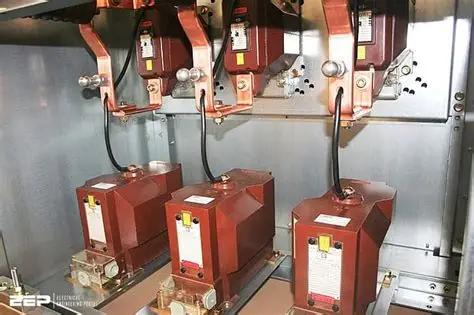
The Essential Interface Between High Voltage and Protection Equipment
Current and voltage transformers serve as the critical interface between high-voltage power systems and the protection, control, and measurement equipment that keeps electrical networks safe and operational. These devices isolate sensitive equipment from dangerous high voltages while providing standardized current and voltage signals—typically 1 or 5 amperes for current coils and 120 volts for voltage coils.
Without these transformers, protection relays and measurement devices would require direct connection to high-voltage circuits, creating insurmountable safety and technical challenges. Instead, these transformers create a safe, standardized interface that enables sophisticated protection and control systems to operate effectively.
Current Transformers: The Foundation of Protection Systems
Understanding Current Transformer Function
Current transformers (CTs) create a scaled representation of primary high-voltage current at much lower, safer levels. Beyond current scaling, CTs provide crucial electrical isolation, allowing protection relays to operate at nominal 1000V insulation levels rather than requiring full high-voltage insulation.
This dual function—current transformation and electrical isolation—makes CTs indispensable throughout high-voltage installations. However, selecting the appropriate CT requires careful consideration of the specific application and consultation with switchgear manufacturers.
Measurement vs. Protection Class CTs
The distinction between measurement and protection class CTs reflects their fundamentally different operational requirements:
Measurement Class CTs operate over a limited current range up to the circuit’s full-load rating. These transformers prioritize accuracy under normal operating conditions but would be destroyed by the extreme currents encountered during fault conditions.
Protection Class CTs must function reliably at current levels many times greater than full-load current—precisely the conditions that would destroy measurement-class units. This capability is essential because protection systems must operate correctly during the most severe fault conditions.
Construction and Design Principles
Basic Construction
A current transformer consists of an iron core constructed from specially wound strips of sheet steel or other magnetic alloys. The secondary winding, wound around this core, must be properly insulated and sized to carry the required fault current. The entire assembly is protected by insulation layers or epoxy resin casting.
The primary conductor passes through the CT core, effectively forming a single-turn primary winding. For applications with low primary currents (less than 50 amperes), insufficient flux density would prevent reliable operation, so CTs may incorporate wound primaries with multiple turns of large cross-sectional conductors.
Busbar Bushing Type CTs
An alternative design embeds a copper busbar directly in resin, with the busbar ends forming the primary terminals. This configuration always uses a single primary turn, with secondary terminals brought out externally for connection to protection and measurement circuits.
Protection CT Classification and Accuracy
Accuracy Classes
Protection CTs use different accuracy standards than measurement units, reflecting their operational requirements:
- 5P Class: Maintains 5% accuracy up to the rated accuracy limit
- 10P Class: Maintains 10% accuracy up to the rated accuracy limit
These accuracy levels, while less precise than measurement CTs (which can achieve 0.1% accuracy), are appropriate for protection applications where fault detection is more important than precise measurement.
Accuracy Limit Factor (ALF)
The Accuracy Limit Factor defines the multiple of rated current up to which the CT maintains its specified accuracy. Standard ALF values include 5, 10, 15, 20, and 30.
Practical Example: A 50:1 CT protecting a circuit where fault currents may reach 1000A requires an ALF of 20 (1000 ÷ 50 = 20). At this fault level, the secondary current would nominally be 20A, but allowing for 10% error, it could be as low as 18A. Beyond this point, core saturation may occur, limiting further current increase.
Short-Time Current Rating
CTs must withstand the thermal and magnetic stresses of fault currents for specified durations. The short-time current rating defines the RMS alternating current the CT can carry without damage for rated times of 0.25, 0.5, 1.0, 2.0, or 3.0 seconds.
Example Calculation: A 200:5 CT rated for 13kA for three seconds has a short-time factor of 65 (13,000 ÷ 200 = 65). For lower currents, the withstand time increases according to the relationship: t₂ = t₁ × (I₁/I₂)², where reduced current (I₂) extends the allowable time (t₂).
Critical Safety Considerations
Never open-circuit a CT secondary while primary current flows. When the secondary opens, the CT attempts to function as a step-up voltage transformer, potentially generating voltages from hundreds of volts to many kilovolts. These dangerous voltages threaten:
- CT insulation integrity
- Connected equipment safety
- Personnel safety
Before disconnecting any CT secondary circuit, always short-circuit the secondary terminals using conductors capable of carrying potential fault currents.
CT Specification and Selection
Standard Specification Method
IEC 61869-1:2007 defines CTs using three key parameters:
- Burden: 2.5, 5, 7.5, 10, 15, and 30 volt-amperes
- Accuracy Class: 5P (5%) and 10P (10%)
- Accuracy Limit Factor: 5, 10, 15, 20, and 30
Example: A CT specified as “15 VA class 5P20” provides circuit protection with 15 volt-ampere burden capacity and maintains 5% accuracy up to 20 times rated primary current.
Understanding CT Burden
CT burden represents the total load impedance connected to the secondary circuit, expressed in volt-amperes at a specified power factor. The relationship between burden and impedance follows: Total impedance (ohms) = V·A burden ÷ (secondary current)²
Practical Impact: A 5-volt-ampere burden on a 50:1 CT creates 5-ohm secondary impedance. Since burdens connect in series, any additional circuit impedance increases the total CT burden.
Evolution from Electromechanical to Digital Protection
Traditional electromechanical relays imposed significant burdens on CTs—typically 3-5 volt-amperes—with earth-fault elements creating particularly high burdens due to their sensitive settings. These high burdens often required oversized CTs and careful burden calculations.
Modern digital protection relays dramatically reduced this challenge, typically requiring only 0.25 volt-amperes. This fixed, low burden simplifies CT selection and enables more sensitive protection settings, particularly for earth-fault applications.
Class ‘X’ Specification for Specialized Applications
For high-sensitivity earth-fault protection and other demanding applications, the standard burden/accuracy/ALF specification proves inadequate. Instead, engineers specify the maximum useful “knee-point voltage” directly.
The knee-point voltage represents the point on the CT magnetization curve where a 50% increase in excitation current produces only a 10% increase in secondary voltage. Since users specify the required voltage directly, the CT “class” becomes unknown—hence the term “class X” specification.
CT Connection Methods for Protection
Residual Current Detection
Earth-fault protection benefits from residual current detection, which responds only to currents flowing to earth. This approach remains unaffected by balanced load currents and enables very sensitive settings limited primarily by system leakage currents.
Typical Connection Arrangements
Standard CT connections include:
- Individual phase monitoring for overcurrent protection
- Parallel connection of line CTs for residual current extraction
- Combined arrangements with phase-fault elements in individual leads and earth-fault elements between star points
Many installations use only two-phase overcurrent protection since this detects all interphase faults while maintaining full earth-fault sensitivity.
Voltage Transformers: Voltage Sensing and Directional Protection
VT Function and Construction
Voltage transformers (VTs) provide secondary voltages proportional to primary system voltages. Like CTs, VTs incorporate primary windings, magnetic cores, and secondary windings, all encapsulated in insulating resin.
Achieving accurate voltage transformation requires minimal winding voltage drops and magnetic flux densities well below saturation levels. This design maintains nearly constant magnetizing impedance across the required operating voltage range.
Applications in Protection Systems
VTs become essential when protection relays must determine fault current direction, requiring both current and voltage information. Directional protection schemes rely on the phase relationship between current and voltage to determine whether faults lie within the protected zone.
VT Accuracy and Specifications
Accuracy Classes
IEC 61869-3 specifies accuracy classes 3P and 6P for protection VTs, with 3P being the standard for most applications. Protection VTs must maintain specified accuracy down to 2% of rated voltage, ensuring reliable operation during abnormal system conditions.
Voltage Factor Considerations
The rated voltage factor (kT) indicates the maximum voltage condition under which the VT maintains specified accuracy and temperature limits. This factor must account for the network earthing arrangement and the time required to clear faults.
VT Voltage Ratings
Primary Voltage: VTs connect either phase-to-earth or phase-to-phase, requiring appropriate voltage ratings for each application. Standard specifications apply only under normal conditions—derating may be necessary for extreme ambient temperatures or high altitudes.
Secondary Voltage: Standard secondary voltages are 100V or 110V for phase-to-phase connections. Single-phase transformers for phase-to-earth connection use secondary voltages divided by √3.
Advanced Sensing Technologies
Non-Inductive Current Sensors
Modern digital relays require minimal power, enabling air-based current sensors (Rogowski coils) and voltage dividers. These non-inductive sensors eliminate magnetic hysteresis effects and offer significant advantages:
Elimination of Saturation
Without iron cores, air-based sensors cannot saturate, eliminating the need for accuracy limit factors and enabling reliable operation at any current level.
Standardization Benefits
Linear response characteristics allow two or three sensor types to cover 95% of applications, simplifying switchgear design and enabling rapid equipment conversion.
Unified Measurement and Protection
Non-inductive sensors eliminate the traditional separation between measurement and protection transformers since precision remains constant and saturation cannot occur.
Signal Processing Requirements
Rogowski coils produce output voltages proportional to the time derivative (di/dt) of primary current. This requires signal processing to extract usable current information, and protective relays must be designed specifically for these signal types.
Optical Current and Voltage Transducers
The evolution toward smart technology and digital substations drives the adoption of optical transducers (Non-Conventional Instrument Transformers – NCITs). These devices measure changes in optical fiber performance when exposed to electric and magnetic fields.
Advantages of Optical Technology
- Immunity: No voltage drop or electromagnetic interference issues
- Size: Significantly smaller than conventional transformers
- Accuracy: Superior linear characteristics and signal reproduction
- Reliability: More accurate reproduction of primary signals
Current Applications
While currently more common in high-voltage and extra-high voltage applications, optical transducers are expected to expand into medium voltage applications as the technology matures and costs decrease.
Conclusion
Current and voltage transformers form the essential bridge between high-voltage power systems and the protection equipment that ensures safe, reliable operation. Understanding their characteristics, limitations, and proper application is crucial for effective protection system design.
The evolution from traditional electromagnetic transformers to modern non-inductive and optical sensors reflects the broader transformation of power system protection. While conventional transformers remain the foundation of most protection systems, emerging technologies promise greater accuracy, simplified standardization, and enhanced reliability.
Proper transformer selection requires careful consideration of accuracy requirements, burden calculations, short-time ratings, and safety implications. As protection systems become increasingly sophisticated, the importance of these fundamental interface devices continues to grow, making their proper understanding essential for all power system engineers.