
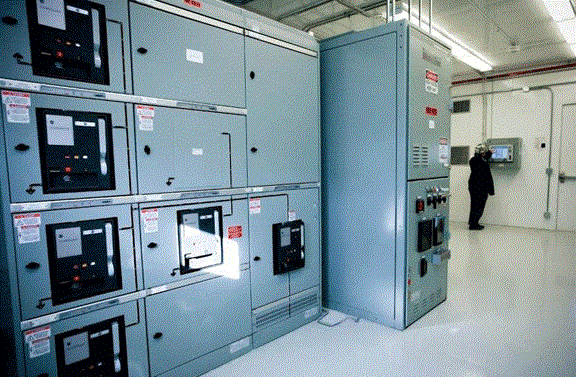
The Art and Science of Protection Coordination
Protection system coordination represents one of the most critical aspects of electrical system design, requiring engineers to balance competing demands for speed, selectivity, and reliability. At the heart of this challenge lies the concept of grading margins—the carefully calculated time intervals between successive protection devices that ensure only the faulty equipment disconnects while maintaining power to healthy sections of the network.
The fundamental challenge in protection coordination stems from the need to distinguish between normal operating conditions, permissible overloads, and genuine fault conditions requiring immediate disconnection. This discrimination must account for maximum expected loads, short-term overloads, motor starting currents, and the relay’s ability to fully reset after transient disturbances. These requirements unfortunately, mean that overcurrent protection primarily addresses short-circuit faults rather than overload conditions, with overload protection typically provided through temperature monitoring systems.
Understanding Grading Margins: The Foundation of Selectivity
Essential Requirements for Relay Settings
Modern relay technology has significantly improved reset characteristics, with numerical relays typically resetting at 95% of their setting current, compared to 70% for older electromechanical units. This improvement allows minimum current settings of approximately 1.05 times the short-term rated current of the protected circuit, providing adequate margin for reliable operation while maintaining sensitivity.
The grading margin—the time interval between successive relay operations—must ensure absolute discrimination between protection devices. This critical timing depends on multiple interrelated factors that must be carefully analyzed and coordinated.
Factors Influencing Grading Margin Calculations
Protective Device Type: Different relay technologies exhibit varying response characteristics. Electromechanical relays require reset margins of up to 15 seconds and can experience “pecking” behavior under repeated transient conditions, where the disc advances incrementally without fully resetting. Modern numerical relays eliminate these concerns with precise reset characteristics and minimal hysteresis.
Fault Current Magnitude: The level of fault current directly influences relay operation time and affects the required grading margin. Higher fault currents generally produce faster relay operation but may also introduce greater timing uncertainties due to CT saturation effects.
Circuit Breaker Performance: The interrupting time of MV fuses or circuit breakers directly impacts the total fault clearing time. Modern vacuum circuit breakers operate significantly faster than older oil or air-blast designs, affecting overall coordination timing.
Relay Timing Accuracy: All protection relays exhibit timing errors compared to their theoretical characteristics. These errors vary by technology type and current magnitude, requiring careful consideration in coordination studies.
Relay Timing Characteristics and Accuracy
Evolution of Timing Precision
The evolution from electromechanical to numerical relays has dramatically improved timing accuracy:
- Electromechanical relays: Typically ±7.5% timing accuracy with significant temperature and aging effects
- Static relays: Improved to approximately ±5% timing accuracy with better temperature stability
- Numerical relays: Achieve ±2-3% timing accuracy with excellent long-term stability
These improvements enable tighter coordination and reduced grading margins while maintaining reliable discrimination.
Operating and Reset Thresholds
Modern relay standards specify precise operating thresholds:
- IEC 60255-151: Traditional IDMT relays must reset at 70% and operate at 130% of the current setting
- Digital relays: Typically reset at 90% and operate at 110% of the setting
- Numerical relays: Advanced units achieve 95% reset and 105% operating values
These improved characteristics enable more precise coordination and reduce the likelihood of unwanted operations during transient conditions.
Relay Overshoot and Electronic Inertia
Mechanical vs. Electronic Overshoot
While overshoot in electromechanical relays results from the physical inertia of rotating discs, modern electronic relays experience equivalent effects from processing delays and signal decay times. This “electronic inertia” must be accounted for in coordination studies, though it typically represents a much smaller time component than mechanical overshoot.
Current Transformer Error Contributions
CT accuracy classifications (5P and 10P) introduce magnitude and phase errors that can affect inverse-time coordination. These errors become particularly significant when fault currents approach or exceed the CT’s accuracy limit factor (ALF), potentially causing coordination schemes to fail if not properly considered.
Safety Margins and Practical Coordination
Establishing Adequate Safety Margins
Beyond accounting for known errors and operating times, successful coordination requires safety margins to ensure upstream relays don’t initiate tripping while downstream devices are clearing faults. Recommended practices suggest minimum grading margins of:
- Electromechanical systems: 0.4-0.5 seconds
- Mixed electromechanical/static systems: 0.3-0.4 seconds
- Modern numerical systems: 0.2-0.3 seconds
Practical Grading Margin Calculation
A comprehensive grading margin calculation considers all error sources:
t’ = 2ER × t + ECT × t + tCB + tO + tS
Where:
- t’ = minimum grading margin (seconds)
- ER = relay timing error (%)
- ECT = CT ratio error allowance (%)
- t = nominal operating time of nearest relay (seconds)
- tCB = circuit breaker interrupting time (seconds)
- tO = relay overshoot time (seconds)
- tS = safety margin (seconds)
This formula provides a systematic approach to determining appropriate grading margins while accounting for all significant error sources.
Relay Operating Characteristics
Definite Time Relays: Simplicity with Limitations
Definite time (DT) relays operate with fixed time delays once the current exceeds preset thresholds, offering simplicity but significant limitations. The sequential operation concept—shortest time nearest the fault, progressively longer times toward the source—creates a fundamental problem: faults nearer the source (with higher fault currents) may take longer to clear than distant faults.
Typical DT Relay Specifications:
- Current setting range: 0.1 to 24 × rated current
- Time setting range: 0.05 to 300 seconds
- Operating time: 20-40 milliseconds
- Reset time: 50 milliseconds
While DT relays serve specific applications, their inability to adapt clearing times to fault severity limits their use in comprehensive protection schemes.
Inverse Definite Minimum Time (IDMT) Characteristics
IDMT relays represent the cornerstone of modern protection coordination, offering operating times inversely related to fault current magnitude. This characteristic ensures faster clearing of more severe faults while maintaining discrimination through carefully selected time multiplier settings.
Standard Inverse (SI) Characteristic
The SI characteristic provides the foundation for most coordination studies:
t = TMS × (0.14 / (M^0.02 – 1))
Where:
- t = operating time (seconds)
- TMS = time multiplier setting
- M = current multiple (I/Is)
This characteristic offers excellent coordination capability and forms the basis for “natural grading” where all relays use identical characteristics with different TMS values.
Very Inverse (VI) Characteristic
The VI characteristic provides enhanced discrimination for circuits with significant impedance differences:
t = TMS × (13.5 / (M – 1))
This characteristic proves particularly effective across MV/LV transformers where transformer impedance creates substantial fault current differences between primary and secondary faults.
Extremely Inverse (EI) Characteristic
The EI characteristic offers superior coordination with fuses and handles high inrush currents:
t = TMS × (80 / (M² – 1))
Being approximately inversely proportional to current squared, this characteristic provides excellent discrimination for circuits experiencing high magnitude current surges during energization.
Long-Time Inverse (LTI) for Standby Earth Fault Protection
The LTI characteristic was developed specifically for neutral earthing resistor protection:
t = TMS × (120 / (M – 1))
This characteristic shares the VI curve shape but operates more slowly, providing appropriate coordination for standby earth fault applications while considering step and touch voltage hazards.
Advanced Coordination Techniques
Logic Discrimination: Eliminating Time Delays
Logic discrimination represents a revolutionary approach to protection coordination, using communication between relays to eliminate traditional time-based discrimination delays. When faults occur, each sensing relay sends blocking signals to upstream devices, preventing their operation while the relay closest to the fault clears the disturbance.
Key Advantages:
- Dramatically reduced fault-clearing times
- Maintains selectivity without time delays
- Reduces equipment thermal and mechanical stresses
- Enables faster system recovery
Implementation Requirements:
- Communication infrastructure between relays
- Sophisticated relay logic programming
- Backup time-based coordination for communication failures
- Careful consideration of blocking signal timing
Typical Logic Discrimination Timing
The effectiveness of logic discrimination depends on precise timing:
- Circuit breaker opening time: 100-200 milliseconds
- Arc extinction time: 30-50 milliseconds
- Communication delay: 10-20 milliseconds
- Logic processing time: 5-10 milliseconds
These short time constants enable fault clearing in 150-300 milliseconds compared to traditional time-graded systems requiring 500-1500 milliseconds.
Challenges and Limitations
Infrastructure Requirements: Logic discrimination demands reliable communication between protection devices, requiring additional cabling or fiber optic infrastructure that increases installation costs, particularly for geographically distributed systems.
System Complexity: The sophisticated logic required for reliable operation increases system complexity and requires specialized expertise for design, commissioning, and maintenance.
Communication Reliability: System operation depends entirely on communication integrity, requiring robust backup systems and fail-safe operating modes.
International Standards and Practices
IEC vs. IEEE Characteristics
While this discussion focuses on IEC standards prevalent in the UK, North American practice follows IEEE (ANSI) C37.112-2018 standards with similar but distinct characteristics. IEEE equations include additional constants and specify reset times to emulate electromechanical relay behavior, reflecting different historical development paths and operating philosophies.
Harmonization Challenges
International projects often require coordination between different protection philosophies and standards, demanding careful analysis to ensure compatibility while meeting local regulatory requirements and utility practices.
Modern Coordination Tools and Techniques
Computer-Based Coordination Studies
Modern protection coordination relies heavily on computer simulation tools that enable comprehensive analysis of complex networks under various operating conditions. These tools facilitate:
- Fault current calculation for all credible system configurations
- Time-current curve plotting for visual verification of coordination
- Sensitivity analysis for varying system parameters
- Optimal setting determination using automated algorithms
Adaptive Protection Systems
Emerging adaptive protection technologies enable real-time adjustment of protection settings based on changing system conditions, potentially revolutionizing traditional coordination approaches by automatically optimizing settings for current network configuration and loading.
Future Trends and Considerations
Smart Grid Integration
As power systems evolve toward smart grid architectures, protection coordination must accommodate:
- Bidirectional power flows from distributed generation
- Dynamic system reconfiguration through automated switching
- Variable impedance sources from renewable energy systems
- Coordinated response to system-wide disturbances
Digitalization Impact
Advanced digital technologies enable new coordination approaches:
- Machine learning for optimal setting determination
- Real-time coordination based on current system state
- Predictive maintenance for protection system components
- Enhanced communication through standardized protocols
Practical Application Guidelines
Systematic Coordination Approach
Successful protection coordination requires a systematic methodology:
- System Analysis: Comprehensive understanding of network topology, operating modes, and fault current distribution
- Device Selection: Appropriate choice of protection technologies based on application requirements
- Setting Calculation: Rigorous application of coordination principles with adequate safety margins
- Verification: Computer simulation and field testing to confirm proper operation
- Documentation: Complete records enabling future modifications and maintenance
Common Coordination Pitfalls
Inadequate Safety Margins: Insufficient grading margins leading to loss of selectivity during unusual operating conditions or equipment aging.
Neglecting CT Performance: Failure to consider CT accuracy limitations and saturation effects, particularly at high fault current levels.
Ignoring System Changes: Coordination schemes that become invalid due to system modifications, load growth, or equipment replacement.
Insufficient Testing: Inadequate commissioning and periodic testing leading to undetected coordination failures.
Conclusion
Protection system coordination represents both an art and a science, requiring a deep understanding of electrical system behavior, protection device characteristics, and the complex interactions between multiple protection elements. The evolution from simple time-graded systems to sophisticated logic-based coordination reflects the increasing complexity and performance demands of modern electrical networks.
Success in protection coordination demands rigorous analysis, careful attention to detail, and a comprehensive understanding of the factors influencing relay operation. As power systems continue evolving with smart grid technologies, distributed generation, and advanced communication capabilities, protection engineers must adapt traditional coordination principles to meet new challenges while maintaining the fundamental objective of reliable, selective fault clearing.
The investment in proper protection coordination pays dividends through improved system reliability, reduced equipment damage, enhanced safety, and minimized service interruptions. As electrical systems become increasingly critical to modern society, the importance of well-coordinated protection systems continues to grow, making mastery of these principles essential for all power system engineers.